Showing posts with label barley. Show all posts

Wednesday, 31 December 2014

The benefits of Cress.


Ibn Al Qayyim (rahimuAllah) mentioned the health benefits of cress in his work 'Prophetic Medicine'. He said that cress was beneficial for, warming and softening the belly, reducing inflammation of the spleen when combined with honey, preventing hair loss, increasing appetite, asthma and clearing the lungs. He also said that if cress seeds are crushed and drunk with hot water, this is beneficial for colic and vitiligo (a chronic condition that causes pale, white patches to develop on the skin).

Cress (botanical name Lepidum sativum) is commonly known as garden cress and is closely related to mustard and watercress. It is an edible plant that, when fully grown, has a peppery flavour and aroma similar to mustard and watercress. It is typically harvested when very young, at the cotyledon leaf stage.

Garden cress contains significant amounts of iodine, iron, calcium, folic acid and vitamins A and C. It is also a source of phytochemicals and antioxidants. It's the iodine content in cress which is so valuable to the human body in today's day and age.

According to a study funded by Australia's Rural Industries Research and Development Corporation (RIRDC), the anti cancer effects of garden cress far outweighed that of other green vegetables tested (the study was conducted on cress vs. some common species of brassicas).


How to Grow Cress.


Cress is very easy to grow. It can be grown all year round in any country, indoors or in the garden in Spring. When grown indoors, either seed trays or wet cotton wool in pots are usually used. It is often grown by children as their first introduction to gardening.

To grow cress in seed trays, lightly sprinkle the seeds onto wet cotton wool or a few layers of wet kitchen paper. Keep the seeds moist throughout germination and place the tray in a bright spot, like a south facing windowsill.

The seeds should begin to sprout in around 2 days. Insha'Allah in 5-7 days, the cress should be ready to harvest.

How to use cress.


Both the leaves and stems of cress can be eaten raw in salads or sandwiches, and are sometimes called cress sprouts. They are delicious and as with all sprouted seeds, they are loaded with vitamins and minerals. Eating raw garden cress is beneficial for women with irregular or suppressed menstruation. It is also very beneficial for them when cooked in soups.

According to Ibn Al Qayyim (rahimuAllah) for the treatment of hair loss, the juice of young garden cress is massaged on the scalp and hair. It can be extracted using a juicer. It is also beneficial for hair loss if it is consumed.

The crushed seeds can be steeped in boiling water for 10 mins and drunk as a hot infusion for the treatment of viscous phlegm build up in the chest and lungs (bronchitis, chest infections) by helping the patient cough it out. This decoction also benefits asthma sufferers as does eating raw cress in general.

According to Ibn Al Qayyim (rahimuAllah), patients with sciatica can make a pomade of cress leaves, barley stems and halaal vinegar (blend them to a paste in a food processor) and apply this mixture to the affected area, wrapping it with cling film so that it does not dry out. My personal advice is to leave it for an hour, then wash it off. Used with Hijaama wet cupping, Allah will bring relief insha'Allah.

Friday, 12 December 2014

Authentic Narrations regarding Talbina


Basic Talbinah

A'ishah (may Allah be pleased with her) used to recommend Talbina for the sick and for the one grieving over a dead person. She (may Allah be pleased with her) used to say, "I heard the Messenger (Sallallaahu alayhi Wasallam) saying, ' The talbina gives rest to the heart of the patient and makes it active and relieves some of his sorrow and grief.' "
[Saheeh al-Bukhaari (5325)].

A'ishah (may Allaah be pleased with her) also said that whenever one of her relatives died, the women assembled and then dispersed (returned to their houses) except her relatives and close friends. She (may Allah be pleased with her) would order that a pot of talbina be cooked. Then Tharid (a dish prepared from meat and bread) would be prepared and the talbina would be poured over it. Aisha (may Allah be pleased with her) would say (to the women),"Eat from it, for I heard the Messenger (Sallallaahu alayhi Wasallam) saying 'The talbina soothes the heart of the patient and relieves him from some of his sadness.' "
[Saheeh al-Bukhaari (5058)].

Hisham's father (may Allah be pleased with them both) said, "A'ishah (may Allah be pleased with her) used to recommend talbina and used to say, 'It is disliked (by the patient) although it is beneficial.'"
[Saheeh al-Bukhaari (5326)].

The Messenger (Sallallaahu alayhi Wasallam) said, "I encourage you to use that which is disliked but beneficial (talbina) for by the One whose hand Muhammad's soul is in, it cleans the stomach of one of you just as dirt is cleaned from the face with water."
[Mustadrak of Haakim (7455), Saheeh as Dhahabi mentioned in 'Talkhees' taken from Maktaba Shaamilah, See also Mustadrak (8245) whose chain is upon the condition of Bukhaari as Dhahabi mentioned].

A'ishah (may Allah be pleased with her) narrated, "If any of the Messenger's (Sallallaahu alayhi Wasallam) family became ill, the Messenger (Sallallaahu alayhi Wasallam) would say, 'It soothes the grieving heart and cleanses the ailing heart just as one of you cleans dirt off his face with water.' "
[Saheeh Sunan Ibn Maajah (3445), hadeeth is hasan].

A'ishah (may Allah be pleased with her) narrated that the Messenger (Sallallaahu alayhi Wasallam) said, "You should eat the beneficial thing that is unpleasant to eat (talbina), meaning broth." If any member of the Messenger of Allaah's family was sick, the cooking pot would remain on the fire until one of two things happened, either the person recovered or died."
[Saheeh Sunan Ibn Maajah (3446) hadeeth is hasan].

Recipe For Talbina;

Talbina is made by adding 1-2 tablespoons of barley flour (must be 100% wholegrain barley flour) to one and a half cups of water. Place on low heat for 10-15 minutes (optional: add milk or yoghurt and sweeten with honey). This may also be used as a food thickener for gravy, soups, lasagnes dishes etc. Alternatively you may add 1-2 tablespoons of barley flour (must be 100% wholegrain barley flour) to one and a half cups of milk. Place on low heat for 10-15 minutes (optional: add water or yoghurt and sweeten with honey).

The consistency may be changed according to preference by increasing or decreasing the amount of flour used. More flour may be added to make it thick like a porridge. Alternatively less flour may be added to make a drink like soup.


It is my understanding based upon what Ibn Al Qayyim has mentioned that it was traditionally made with water instead of milk and its consistency was thin like that of a broth and Allah knows best.

Talbinah Porridge is a valuable and healthy breakfast for everyone, particularly these types of patients;


Diabetics and Pre Diabetics -
Reduce the quantity of honey to 1/4 a teaspoon (or less) per serving. Top the talbinah with toasted sesame seeds and a pinch of cinnamon. Or you can grind the sesame seeds and cook both ingredients into the talbinah.

Hypertension or heart diseases -
Serve Talbinah with quince preserve, or sprinkle roasted date stone flour, or roasted ground flaxseeds. Or stir in one tablespoon of pomegranate vinegar or homemade pomegranate molasses made with honey instead of sugar. Eliminate sodium chloride from the diet. Use pink Himalayan salt in all cooking.

Stroke patients -
Add a pinch of turmeric when making the talbinah. Drink Nabeez made with raisins, natural pomegranate juice or cranberry juice.

Patients with chronic pain or arthritis -
Make the talbinah with crushed fresh ginger, a pinch of white pepper and honey.  Drink green tea.

Patients with digestive disorders -
Where the stomach and digestive functions are impaired, make Talbinah thinner in consistency. The sawwiq barley flour should be 100% wholemeal and it can be roasted in a small amount of olive oil before water or milk is added. This helps it assimilate easily. Increase the ratio of water and reduce the ratio of milk. Be sure to add honey.

For those on the road to recovering from an illness -
Make it with ground almonds. These give energy and strength. Top with raisins.

For kids -
Top with ripe sliced banana and drizzle with honey. Make it with cocoa powder. Or stir in date paste and top with flax seeds and chopped nuts.

For those who are very sick, with no hope of recovery (dying) and for their close relatives - 
Talbinah should be provided to them and it can be made with honey.

Monday, 1 September 2014

Pearl Barley and Vegetable Soup Recipe.


Asalaamu alaikum warahmatullaahi wabakatu all,

Barley was the grain most frequently consumed by the Messenger of Allah (sallAllahu alayhi wassallam). It is full of vitamins, minerals and fiber.

Ibn Al Qayyim (rahimullah) suggested that the broth in which barley is boiled is more nutritious than its flour. Barley broth helps against coughing and throat roughness, stimulates the body to remove waste, cleanses the stomach, quenches the thirst and extinguishes heat. It also provides comfort and has a decomposing quality.

Ibn Al Qayyim (rahimullah) said regarding making barley water to drink that the barley should be boiled in 5 times its own amount of water in a clean pot. It should be placed on a low heat and cooked until only two fifths of the mixture remains. Then remove the cooked barley grains and use the remaining water as required.

Winter is on its way in many countries so here is my recipe for mixed vegetable soup with pearl barley. This easy to make healthy soup is delicious enjoyed with a slice of homemade bread spread with a small amount of ghee.

1 cup pearl barley, soaked for a minimum of 10 hours in enough clean water to cover, drained.
5 cups of boiling water
4x vegetable stock cubes
3 tablespoons of olive oil
1 large onion roughly chopped
3 celery stems, chopped
3 cloves of garlic, finely chopped
Mixed vegetables of your choice - I used diced carrots, sliced green beans, sliced celery stalks, peeled potato cut into chunks, sweetcorn and courgette. You can add swiss chard, turnips, swede, cauliflower, spinach, butternut squash chunks etc.
1 carton/tin of chopped tomatoes in their natural juice.
Salt, pepper and spices to your taste.

Firstly heat the oil in a pot, add the onions, garlic and celery. Cook while stirring until the mixture turns translucent. There is no need to brown it.

Then add all the other ingredients. Bring to the boil, then cover the pot with a lid, lower the heat down to minimum and cook for 55 mins to 1 hour, stirring occasionally.

Simmering soup. The aroma in my kitchen was amazing :)

The barley grains will swell and soak in a lot of the water. Be sure to add more water if the mixture becomes too thick during the cooking process.

Then it is ready to serve. This soup also freezes really well so you can enjoy it anytime.

White-stemmed swiss chard beet is a preferred vegetable to add in barley soup, particularly for the convalescing.


Umm Al-Mundhir (radhi Allahu anha) narrated that "The Messenger of Allah (sallAllahu alayhi wassallam) entered upon me, while 'Ali (radhi Allahu anhu) was accompanying him, and we had a cluster of unripe dates hanging." The Messenger of Allah began eating from them, whilst 'Ali also wanted to eat from them. She said, "The Messenger of Allah (sallAllahu alayhi wassallam) said to 'Ali, 'Stop, stop, for you are still recovering.' So 'Ali sat and the Prophet ate." She said, 'I made some chard and barley [soup] for them, so the Prophet said, 'O 'Ali eat from this, for indeed it will be more suitable for you.'"
Jami at Tirmidhi Book 28, Hadith 2170. The isnad is hasan (Darussalam).

It was also narrated that Sahl Ibn Sa'd (radhi Allahu anhu) said, "We used to be happy on Fridays. We had an old woman who would take the roots of chard beet and put them in her cooking pot, and she would add grains of barley. When we had prayed [Jummu'ah], we would visit her and she would bring it to us and we would be happy on Fridays because of that. We would not eat lunch or take a nap until after Jummu'ah, and, by Allah, there was no fat in it."
Bukhaari and Muslim

Reference to Healing with the Medicine of the Prophet (sallAllahu alayhi wassallam). Darussalam 2003. Page 286.

Further info on Barley's benefits - http://www.whfoods.com/genpage.php?tname=foodspice&dbid=127


Sunday, 15 September 2013

Foods, drinks and herbs mentioned in the Holy Qur'an.


A summary of the majority of the wonderful foods, drinks and herbs mentioned by Allah Azzawajjal in the Holy Qur'an.


Olives and olive oil.


Surah An Noor [24:35]
"Allah is the Light of the heavens and the earth. The example of His light is like a niche within which is a lamp, the lamp is within glass, the glass as if it were a pearly [white] star lit from [the oil of] a blessed olive tree, neither of the east nor of the west, whose oil would almost glow even if untouched by fire. Light upon light. Allah guides to His light whom He wills. And Allah presents examples for the people, and Allah is Knowing of all things."

Surah At Tin [95:1]
"By the fig and the olive."

Surah Abasa [80:29]
"And olives and palm trees."

Surah Al Mu'minoon [23:20]
"And [We brought forth] a tree issuing from Mount Sinai which produces oil and food for those who eat."

Surah An Nahl [16:11]
"He causes to grow for you thereby the crops, olives, palm trees, grapevines, and from all the fruits. Indeed in that is a sign for a people who give thought."                                  

Sweet smelling herbs.


Surah Ar Rahmaan [55:12]
"And grain having husks and sweet scented plants."

Fish.


Surah An Nahl [16:14]
"And it is He who subjected the sea for you to eat from it tender meat and to extract from it ornaments which you wear. And you see the ships plowing through it, and [He subjected it] that you may seek of His bounty; and perhaps you will be grateful."

Grapes.


Surah Al Mu'minoon [23:19]
"And We brought forth for you thereby gardens of palm trees and grapevines in which for you are abundant fruits and from which you eat."

Garlic and/or Onions.


Surah Al Baqarah [2:61]
"And [recall] when you said, "O Moses, we can never endure one [kind of] food. So call upon your Lord to bring forth for us from the earth its green herbs and its cucumbers and its garlic and its lentils and its onions." [Moses] said, "Would you exchange what is better for what is less? Go into [any] settlement and indeed, you will have what you have asked." And they were covered with humiliation and poverty and returned with anger from Allah [upon them]. That was because they [repeatedly] disbelieved in the signs of Allah and killed the prophets without right. That was because they disobeyed and were [habitually] transgressing."

Corn and/or Wheat and other grains with husks.


Surah Ar Rahmaan [55:12]
"And grain having husks and sweet scented plants."

Ginger.


Surah Al Insaan [76:17]
"And they will be given to drink a cup [of wine] whose mixture is of ginger."

Pomegranate.


Surah Ar Rahmaan [55:68]
"In both of them are fruit and palm trees and pomegranates."

Dates.


Surah Maryam [19:25]
"And shake toward you the trunk of the palm tree; it will drop upon you ripe, fresh dates."

Meat.


Surah Al Ma'idah [5:4]
"They ask you, [O Muhammad], what has been made lawful for them. Say, "Lawful for you are [all] good foods and [game caught by] what you have trained of hunting animals which you train as Allah has taught you. So eat of what they catch for you, and mention the name of Allah upon it, and fear Allah ." Indeed, Allah is swift in account."

Bananas.


Surah Al Waqiy'ah [56:29]
"And [banana] trees layered [with fruit]."

Lentils.


Surah Al Baqarah [2:61]
"And [recall] when you said, "O Moses, we can never endure one [kind of] food. So call upon your Lord to bring forth for us from the earth its green herbs and its cucumbers and its garlic and its lentils and its onions." [Moses] said, "Would you exchange what is better for what is less? Go into [any] settlement and indeed, you will have what you have asked." And they were covered with humiliation and poverty and returned with anger from Allah [upon them]. That was because they [repeatedly] disbelieved in the signs of Allah and killed the prophets without right. That was because they disobeyed and were [habitually] transgressing."
  

Gourds and/or Squashes and Pumpkins.


Surah As Saffaat [37:146]
"And We caused to grow over him a gourd vine."

Cucumbers.


Surah Al Baqarah [2:61]
"And [recall] when you said, "O Moses, we can never endure one [kind of] food. So call upon your Lord to bring forth for us from the earth its green herbs and its cucumbers and its garlic and its lentils and its onions." [Moses] said, "Would you exchange what is better for what is less? Go into [any] settlement and indeed, you will have what you have asked." And they were covered with humiliation and poverty and returned with anger from Allah [upon them]. That was because they [repeatedly] disbelieved in the signs of Allah and killed the prophets without right. That was because they disobeyed and were [habitually] transgressing."

Figs.


Surah At Tin [95:1]
"By the fig and the olive."

Fresh Spring Water.


Surah Al Mursallat [77:41]
"Indeed, the righteous will be among shades and springs."

Milk.


Surah An Nahl [16:66]
"And indeed, for you in grazing livestock is a lesson. We give you drink from what is in their bellies - between excretion and blood - pure milk, palatable to drinkers."

Surah Al Mu'minoon [23:21]
"And indeed, for you in livestock is a lesson. We give you drink from that which is in their bellies, and for you in them are numerous benefits, and from them you eat."

Surah Muhammad [47:15]
"Is the description of Paradise, which the righteous are promised, wherein are rivers of water unaltered, rivers of milk the taste of which never changes, rivers of wine delicious to those who drink, and rivers of purified honey, in which they will have from all [kinds of] fruits and forgiveness from their Lord, like [that of] those who abide eternally in the Fire and are given to drink scalding water that will sever their intestines?"

Honey.


Surah An Nahl [16:69]
"Then eat from all the fruits and follow the ways of your Lord laid down [for you]." There emerges from their bellies a drink, varying in colours, in which there is healing for people. Indeed in that is a sign for a people who give thought."

Wednesday, 2 January 2013

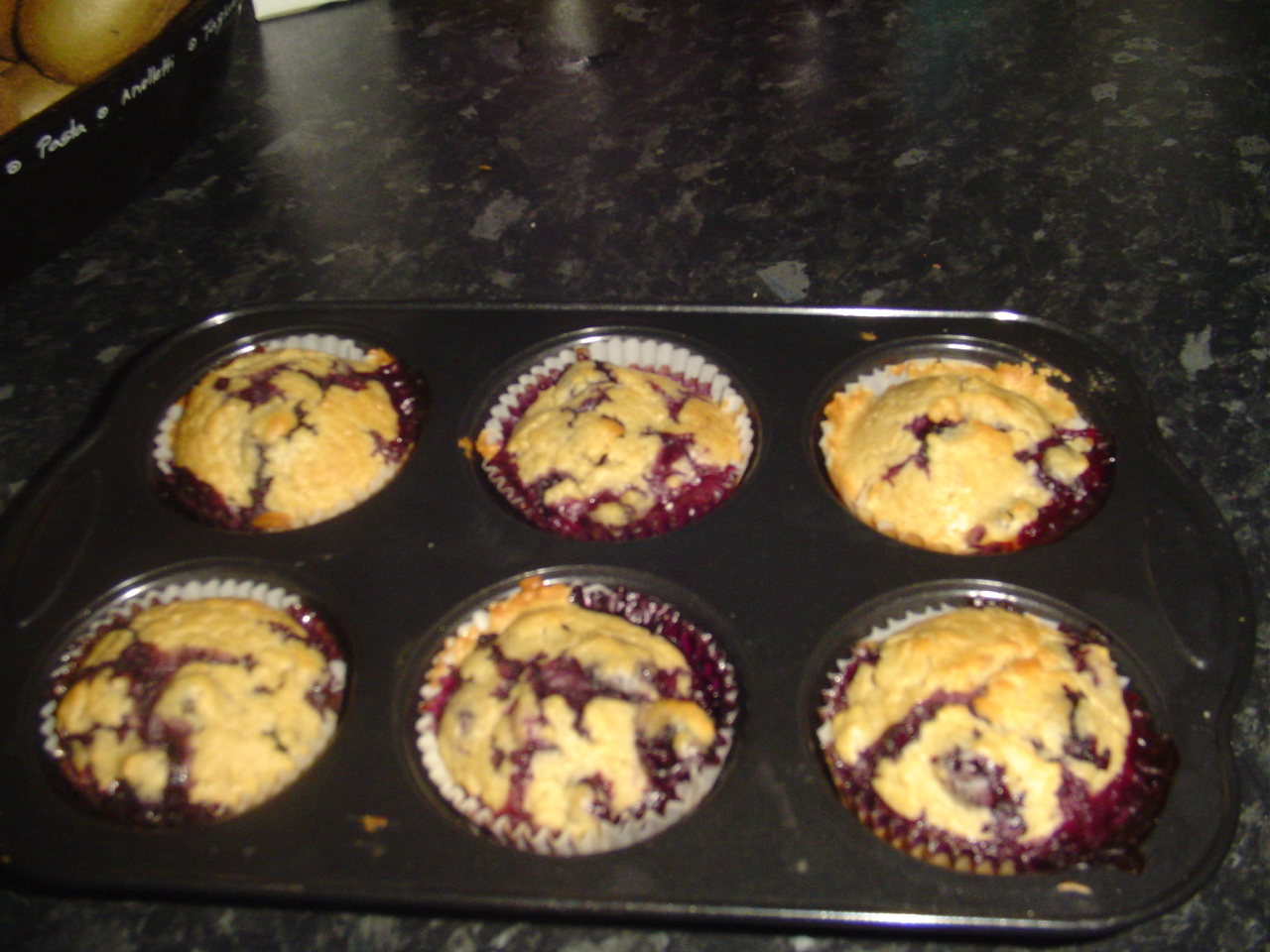
Barley & Blueberry Muffins Recipe.

Here is a great recipe for Blueberry Muffins made with healthy Barley flour, as opposed to normal wheat flour (Maida). Recipe and photos have been provided by our sister Farheen. 

Barley is a low GI grain with a higher fibre content and lower gluten content than wheat, making it much more beneficial for digestion by those patients who are trying to cut down on their consumption of sugar. If you are only able to find Barley grains in the market, you can try to gently roast then before crushing them into flour. Roasting can be done in a frying pan over a low heat using a drop of olive oil. Keep stirring the grains so that they brown evenly and do not burn.

Sister Farheen's recipe makes use of olive oil in place of the usual butter/ghee/shortening which is used in baking;


Ingredients (makes approx 6 muffins);

150g barley flour
50g brown sugar
1/2 tsp baking powder
Pinch of salt 
1 egg, (beaten)
50g olive oil 
100ml milk 
75g fresh blueberries, you can use chopped raisins or dates.
 
Heat the oven to 200 degrees Fahrenheit and line a 6-hole muffin tin with paper cases. Mix the egg, blessed oil and milk quickly into the dry ingredients with the blueberries (don't over mix, it should be a bit lumpy). Divide between the cases and bake for 25 minutes until risen, turns golden and cooked through.
 
Fresh from the oven

Tuesday, 8 May 2012

Nourishment for the convalescing

Swiss Chard, cortesy of www.JohnHarveyPhoto.com)
Narrated in Sunan Ibn Majah, Umm Al Munthir daughter of Qays al-Ansariyyah, radiya Allahu anhaa said: "The Messenger of Allah, salalahu alaihi wa sallam, entered my tent with 'Ali, radiya Allahu anhu,  who was recuperating from an illness. We had an adjacent palm tree with cluster of dates hanging from it. The Messenger of Allah, salalahu alaihi wa sallam, stood up and ate from it, and 'Ali, radiya Allahu anhu, followed suit. The Messenger of Allah, salalahu alaihi wa sallam, addressed ' Ali, radiya Allahu anhu, by saying: ' Gently, gently, you are still convalescing.' 'Ali, radiya Allahu anhu stopped eating. Immediately, I went and prepared a dish of Swiss card beets cooked with barley for him. The Messenger of Allah, salalahu alaihi wa sallam, then addressed ' Ali, saying ' Eat this food. It is more suitable for your present condition.'
Swiss chard beets, known as Silq amongst the Arabic speaking, is a tall, leafy green vegetable member of the beet family.  Its taste is like a cross between spinach and beets.

      Swiss chard beets ( stalks and leaves) cooked with barley together provide the best nourishment for one who is recovering from an illness, as the Prophetic traditions indicate. This meal protects the digestive juices against putrefaction, while it supplies sustaining nutrients to a delicate stomach. Adding Swiss chard beets to one's diet opens obstruction of the liver and spleen.  Black chard when eaten with lentils reduces stomach burns and helps to prevent peptic ulcers. Caution should be used eating chard in excess, as it can cause constipation and bloating, can produce insulin deficiency ( i.e. diabetes), and biliousness in the blood.  However, vinegar and mustard with the meal balances such effects.

 Chard is an excellent source of vitamin K, Vitamin A, Vitamin C, magnesium, manganese, potassium, iron, Vitamin E and dietary fiber. It is a very good source of copper, calcium, vitamin B2, vitamin B6 and protein. In addition, swiss chard is a good source of phosphorus, vitamin B1, zinc, folate, biotin, niacin and pantothenic acid.  Healthy Muslim.com

Here are some other  benefits of using Swiss chard for a number of different conditions:

 Alopecia- due to its astringent properties, applying the water of the dark variety of Swiss chard beets to the hair is a treatment for hair loss.
  
Lice: applying the water also kills head lice

Skin discoloration: applying the water is used as a treatment for skin discoloration of the face and chest and reduces large skin markings (lichen)

Impetigo: applying a pomade of crushed Swiss chard leaves mixed with honey is used for treating eruption of the skin pustules


 Swiss chard beets, are both hot and dry carrying a coolness to the body which affects decomposition, dilates the vessels, and promotes bowel movements, thus preventing digestive tract cancer This is a great food which provides nourishment to the body while it aids in complete digestion and proper elimination of the body systems. 


LinkWithin

Related Posts Plugin for WordPress, Blogger...