Showing posts with label olive. Show all posts

Sunday, 15 September 2013

Foods, drinks and herbs mentioned in the Holy Qur'an.


A summary of the majority of the wonderful foods, drinks and herbs mentioned by Allah Azzawajjal in the Holy Qur'an.


Olives and olive oil.


Surah An Noor [24:35]
"Allah is the Light of the heavens and the earth. The example of His light is like a niche within which is a lamp, the lamp is within glass, the glass as if it were a pearly [white] star lit from [the oil of] a blessed olive tree, neither of the east nor of the west, whose oil would almost glow even if untouched by fire. Light upon light. Allah guides to His light whom He wills. And Allah presents examples for the people, and Allah is Knowing of all things."

Surah At Tin [95:1]
"By the fig and the olive."

Surah Abasa [80:29]
"And olives and palm trees."

Surah Al Mu'minoon [23:20]
"And [We brought forth] a tree issuing from Mount Sinai which produces oil and food for those who eat."

Surah An Nahl [16:11]
"He causes to grow for you thereby the crops, olives, palm trees, grapevines, and from all the fruits. Indeed in that is a sign for a people who give thought."                                  

Sweet smelling herbs.


Surah Ar Rahmaan [55:12]
"And grain having husks and sweet scented plants."

Fish.


Surah An Nahl [16:14]
"And it is He who subjected the sea for you to eat from it tender meat and to extract from it ornaments which you wear. And you see the ships plowing through it, and [He subjected it] that you may seek of His bounty; and perhaps you will be grateful."

Grapes.


Surah Al Mu'minoon [23:19]
"And We brought forth for you thereby gardens of palm trees and grapevines in which for you are abundant fruits and from which you eat."

Garlic and/or Onions.


Surah Al Baqarah [2:61]
"And [recall] when you said, "O Moses, we can never endure one [kind of] food. So call upon your Lord to bring forth for us from the earth its green herbs and its cucumbers and its garlic and its lentils and its onions." [Moses] said, "Would you exchange what is better for what is less? Go into [any] settlement and indeed, you will have what you have asked." And they were covered with humiliation and poverty and returned with anger from Allah [upon them]. That was because they [repeatedly] disbelieved in the signs of Allah and killed the prophets without right. That was because they disobeyed and were [habitually] transgressing."

Corn and/or Wheat and other grains with husks.


Surah Ar Rahmaan [55:12]
"And grain having husks and sweet scented plants."

Ginger.


Surah Al Insaan [76:17]
"And they will be given to drink a cup [of wine] whose mixture is of ginger."

Pomegranate.


Surah Ar Rahmaan [55:68]
"In both of them are fruit and palm trees and pomegranates."

Dates.


Surah Maryam [19:25]
"And shake toward you the trunk of the palm tree; it will drop upon you ripe, fresh dates."

Meat.


Surah Al Ma'idah [5:4]
"They ask you, [O Muhammad], what has been made lawful for them. Say, "Lawful for you are [all] good foods and [game caught by] what you have trained of hunting animals which you train as Allah has taught you. So eat of what they catch for you, and mention the name of Allah upon it, and fear Allah ." Indeed, Allah is swift in account."

Bananas.


Surah Al Waqiy'ah [56:29]
"And [banana] trees layered [with fruit]."

Lentils.


Surah Al Baqarah [2:61]
"And [recall] when you said, "O Moses, we can never endure one [kind of] food. So call upon your Lord to bring forth for us from the earth its green herbs and its cucumbers and its garlic and its lentils and its onions." [Moses] said, "Would you exchange what is better for what is less? Go into [any] settlement and indeed, you will have what you have asked." And they were covered with humiliation and poverty and returned with anger from Allah [upon them]. That was because they [repeatedly] disbelieved in the signs of Allah and killed the prophets without right. That was because they disobeyed and were [habitually] transgressing."
  

Gourds and/or Squashes and Pumpkins.


Surah As Saffaat [37:146]
"And We caused to grow over him a gourd vine."

Cucumbers.


Surah Al Baqarah [2:61]
"And [recall] when you said, "O Moses, we can never endure one [kind of] food. So call upon your Lord to bring forth for us from the earth its green herbs and its cucumbers and its garlic and its lentils and its onions." [Moses] said, "Would you exchange what is better for what is less? Go into [any] settlement and indeed, you will have what you have asked." And they were covered with humiliation and poverty and returned with anger from Allah [upon them]. That was because they [repeatedly] disbelieved in the signs of Allah and killed the prophets without right. That was because they disobeyed and were [habitually] transgressing."

Figs.


Surah At Tin [95:1]
"By the fig and the olive."

Fresh Spring Water.


Surah Al Mursallat [77:41]
"Indeed, the righteous will be among shades and springs."

Milk.


Surah An Nahl [16:66]
"And indeed, for you in grazing livestock is a lesson. We give you drink from what is in their bellies - between excretion and blood - pure milk, palatable to drinkers."

Surah Al Mu'minoon [23:21]
"And indeed, for you in livestock is a lesson. We give you drink from that which is in their bellies, and for you in them are numerous benefits, and from them you eat."

Surah Muhammad [47:15]
"Is the description of Paradise, which the righteous are promised, wherein are rivers of water unaltered, rivers of milk the taste of which never changes, rivers of wine delicious to those who drink, and rivers of purified honey, in which they will have from all [kinds of] fruits and forgiveness from their Lord, like [that of] those who abide eternally in the Fire and are given to drink scalding water that will sever their intestines?"

Honey.


Surah An Nahl [16:69]
"Then eat from all the fruits and follow the ways of your Lord laid down [for you]." There emerges from their bellies a drink, varying in colours, in which there is healing for people. Indeed in that is a sign for a people who give thought."

Wednesday, 2 January 2013

Barley & Blueberry Muffins Recipe.

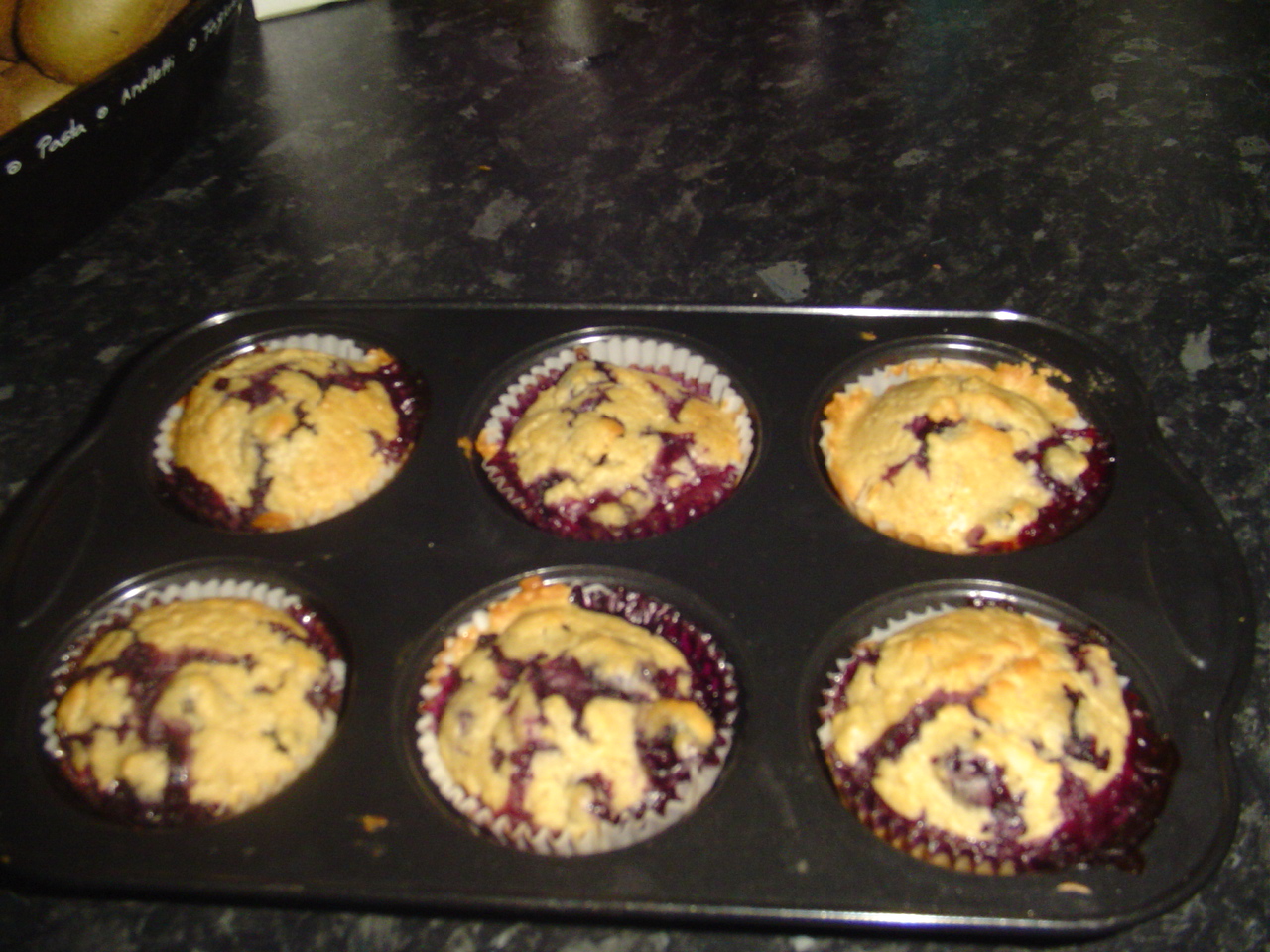
Here is a great recipe for Blueberry Muffins made with healthy Barley flour, as opposed to normal wheat flour (Maida). Recipe and photos have been provided by our sister Farheen. 

Barley is a low GI grain with a higher fibre content and lower gluten content than wheat, making it much more beneficial for digestion by those patients who are trying to cut down on their consumption of sugar. If you are only able to find Barley grains in the market, you can try to gently roast then before crushing them into flour. Roasting can be done in a frying pan over a low heat using a drop of olive oil. Keep stirring the grains so that they brown evenly and do not burn.

Sister Farheen's recipe makes use of olive oil in place of the usual butter/ghee/shortening which is used in baking;


Ingredients (makes approx 6 muffins);

150g barley flour
50g brown sugar
1/2 tsp baking powder
Pinch of salt 
1 egg, (beaten)
50g olive oil 
100ml milk 
75g fresh blueberries, you can use chopped raisins or dates.
 
Heat the oven to 200 degrees Fahrenheit and line a 6-hole muffin tin with paper cases. Mix the egg, blessed oil and milk quickly into the dry ingredients with the blueberries (don't over mix, it should be a bit lumpy). Divide between the cases and bake for 25 minutes until risen, turns golden and cooked through.
 
Fresh from the oven

Friday, 26 November 2010

Olive Oil.


Allah the Almighty speaks of the olive in the Holy Qur’an;

“...Lit from a blessed tree, an olive, neither of the East [so that it only gets the sun’s rays in the morning], nor of the West [so that it only gets the sun’s rays in the afternoon, instead it is exposed to the sun all day long], whose oil would almost glow forth (of itself), although no fire hath touched it.” 
[24:35]

And also;

"By the Fig and the Olive."
[95:1]


It was narrated by 'Umar (radhi Allahu anhu) that he heard the Messenger of Allah (sallallahu alayhi wasallam) say, "Season (your food) with olive oil and anoint yourselves with it, for it comes from a blessed tree."
Sunan Ibn Majah Book 29, Hadith 3444. Graded as Sahih by Darussalaam.

Since olives and their oil are mentioned in both the Qur'an and the Sunnah respectively, they are considered one of the primary healing foods and are therefore recommended to be consumed regularly.

The healing power of olive oil comes in part from its high levels of Mono-unsaturated fatty acids and antioxidants, and in part from the fact that it is well tolerated by the stomach, so it easily breaks down and is an excellent protective emollient for stomach ulcers and gastritis.

All kinds of olive oil are beneficial for softening the skin and slowing down both the skin aging and hair greying processes. It is also known as an anti-inflammatory and beneficial for all kinds of liver and gall bladder problems.

Studies have shown that people who consume around two tablespoons of extra virgin olive oil daily have a lower level of LDL cholesterol in the blood, leading to a lower overall risk of heart disease. Spanish researchers have also found links between olive oil and a reduction in the occurrence of both colon cancer and breast cancer.

The best possible type of olive oil to buy is cold-pressed extra virgin olive oil, which is greenish in colour and contains the highest possible levels of Vitamin E, antioxidants and phenols. This is because it is less processed than commercially refined olive oils. Olive oil is best kept tightly sealed in a cool dark place, as exposure to the air and a light, warm position promotes faster rancidity. Olive oil should be used in place of regular cooking oil in pasta dishes, sauces, stews and curries.

The brine in which olives are bottled is particularly beneficial for strengthening in the gums if used as a mouth rinse.

It is encouraged to use Olive Oil regularly as a moisturiser for the skin and hair.


The use of oil on the body can be traced directly to the Sunnah, where our Mother A'ishah (radhi Allahu anha) also narrated that "The Prophet (sallallahu alayhi wasallam) used to (put) bend his head (out) to me while he was in Itikaaf in the Mosque during my monthly periods and I would comb and oil his hair."
Sahih al Bukhari Volume 3, Book 33, Number 245

Olive oil is great for hair and over time, makes it shiny and silky and easy to manage. It's recommended to massage the scalp with your fingertips when applying olive oil so that its antioxidants are absorbed with greater ease. Olive oil is also used for hair loss, hair strengthening (prevention of split ends) and slowing down the rate of grey hair.

Olive oil is also used by Raqi's when they recite the Qur'an by Allah's Leave for people who are afflicted by sorcery. In sha Allah there is no harm in reciting the Qur'an on olive oil before using it.

Friday, 3 July 2009

Hair care.


Maintaining the health and condition of the hair is an important aspect of the Sunnah of the Messenger of Allah (sallallahu alayhi wasallam). In Sahih al Bukhari, it is narrated that the Messenger of Allah (sallallahu alayhi wasallam) said, “Whoever has hair, let him look after it properly.”


General Hair-care Recommendations;


Wash the hair regularly.


As recorded in Al Bukhari, the Messenger of Allah (sallallahu alayhi wasallam) used to pour water three times on his head, and then rub the hair gently but thoroughly to ensure the whole scalp and roots of the hair had been wetted. The Messenger of Allah (sallallahu alayhi wasallam) first perfumed his head with any beautiful scent which was available; taking it in his hands first he rubbed the right side of the head, then the left side, and finally the middle with the scent. That scent remained on him even after he had finished bathing.

Studies have shown that the best frequency for washing the hair is after every couple of days. The use of a mild medicated shampoo is recommended and it is advised not to shampoo the hair more than once at each washing unless it is very soiled otherwise it may result in brittleness and split ends. A separate rinse with a hair conditioner is also beneficial as it adds softness and helps with combing.

Women who have very long hair which is always plaited must undo the plaits and wash the hair thoroughly after completing the menses. It is not permissible just to make the hair wet or just to wet the tips of the hair.


Starting from the right hand side when combing the hair.


Our Mother A'ishah (radhi Allahu anha) narrated that "The Prophet (sallallahu alayhi wasallam) used to like starting from the right in performing ablution, combing his hair and putting on his shoes."
Sahih al Bukhari Volume 7, Book 72, Number 745

Care when combing wet hair.


Using a fine-toothed comb on wet hair can cause immense stress on the hair shaft when it is wet, which leads to breakage and hair loss. Use a wide-toothed detangling comb and apply a little olive oil if required. Never pull at the hair when combing it.


Allow wet hair to dry naturally.


Using heated blow dryers can strip the hair of its natural moisture, causing split ends, wiriness and breakage. The hair is also more likely to become dry, frizzy and difficult to style.


Massage the scalp regularly with hair oil.


The use of hair oil is directly mentioned in the Sunnah;


Our Mother A'ishah (radhi Allahu anha) also narrated that "The Prophet (sallallahu alayhi wasallam) used to (put) bend his head (out) to me while he was in Itikaf in the Mosque during my monthly periods and I would comb and oil his hair."
Sahih al Bukhari Volume 3, Book 33, Number 245

Massaging gently and regularly (once a week or so) using the fingertips, with any one of the following oils is recommended for increasing circulation and blood-flow to the scalp, thus strengthening the hair roots and conditioning the hair shaft. The best type of olive to use is Olive oil;

It was narrated from ‘Umar (radhi Allahu anhu) that the Messenger of Allah (sallallahu alayhi wasallam) said; "Season (your food) with olive oil and anoint yourselves with it, for it comes from a blessed tree.”
Sunan Ibn Majah  Book 29, Hadith 3444. Classed as Sahih by Darusalaam.

The hair oil can be left on the hair for between 2-4 hours in sha Allah.


Using Henna.


Chemical-based hair colourants and highlights cause great damage to the hair and leak harmful toxins into the blood stream through the pores in the scalp. Henna is a natural dark red dye made from the dried and crushed leaves of the Henna plant. 100% pure Henna is safe to use even by pregnant women. It has hair-strengthening properties and also helps cool down the scalp, reduce headache and migraine, slow down the greying of hair, heal flakiness/itchiness, remove dandruff and kill lice. The use of Henna was the Sunnah of the Companions of our beloved Prophet (sallallahu alayhi wasallam), namely Abu Bakr As Siddique (radhi Allahu anhu) who applied it to his blessed hair and beard.


You can find out more about Henna by clicking here.

Henna should be mixed with an acidic liquid like lemon juice until the mixture forms a thick paste. This should then be covered and left to sit for 24 hours before more lemon juice can be added to make the consistency easier to apply. Henna can be left on the hair for between 2 and 8 hours.

The stain of pure Henna is always dark red/orange in colour. So called ‘Black Henna’ or ‘Brown Henna’ should never be used as it is most certainly a composition of toxic chemicals which could cause a very serious allergic reaction.


Sleeping properly.


Good quality sleep relieves stress which has been linked to hair loss. At the same time it is important to note that over-sleeping does not benefit the body at all and is not recommended. It was the practice of Rasool'Allah (sallallahu alayhi wasallam) and the Companions to sleep for a portion of the night then wake up in the last third of the night for Qiyyam ul Layl.


Improving dietary habits.


The old cliché of eating well really does have a significant impact on the condition of the hair. Eating a balanced diet, low in saturated fat and high in protein, vegetables, fresh fish, vitamins and minerals encourages strong, shiny, bouncy hair. Hair loss can be lessened by avoiding anything which leads to crash dieting, hormonal imbalances, poor blood circulation and anaemia. Regularly drinking a little whole milk, eating almonds, sesame seeds and dried fruit all help the condition of the scalp and hair.

LinkWithin

Related Posts Plugin for WordPress, Blogger...